
How can Stratasys users verify moisture before 3D printing?
Announcements | Thursday, 30th July Share
A completed filament drying cycle does not, by itself, provide a measured result for the water remaining in a Stratasys material.
Drying is an important part of preparing moisture-sensitive filament for FDM printing. However, completing a defined drying cycle does not confirm how much water remains within the material.
The moisture remaining after conditioning can vary with the material’s starting condition, the drying procedure and any subsequent exposure to ambient air. Where material condition forms part of a controlled manufacturing process, recorded drying time and temperature may therefore leave an important question unanswered.
How can Stratasys users verify moisture before 3D printing?
Stratasys users can verify filament moisture by testing a representative sample at the relevant control point, comparing the measured result with the material-specific acceptance limit, and recording the method and result against the relevant batch. A completed drying cycle confirms that the programmed conditioning process has run; it does not directly measure the water remaining in the material.
Why moisture verification matters in controlled FDM workflows
Stratasys FDM systems process thermoplastic materials by heating and depositing them in successive layers. Where a material has absorbed water, that moisture may be released as vapour as the filament passes through the heated print head.
The practical effect depends on the material, moisture level, printing conditions and component requirements. Within Able’s published RAF Stratasys moisture-control application, moisture is linked to surface finish and tensile strength in the context of dimensionally accurate, safety-related production parts.
The level of verification required depends on the material, application and organisation’s quality system. Where material condition must be demonstrated, a recorded drying cycle may not provide sufficient evidence that the required moisture level was achieved.
A moisture-verification step can be introduced at several points:
- When material is received
- After a drying cycle
- Following extended storage
- After suspected exposure to ambient conditions
- Immediately before a controlled or critical build
The appropriate control points depend on the material, production procedure and consequences of using material outside the required condition. The objective is not to test unnecessarily, but to produce a documented result where material condition must be demonstrated.
Why a completed drying cycle is not a moisture measurement
A drying cabinet or oven controls a conditioning process and may record operating parameters such as time and temperature. These parameters do not directly report the water remaining in the filament.
Completion of the programme confirms that the selected cycle has run. It does not necessarily confirm that:
- The material entered the dryer at the expected moisture level
- The selected cycle was appropriate for the material
- The required moisture limit was reached
- The material remained within that limit after removal or storage
Drying and measurement therefore perform different functions. One conditions the material, while the other verifies its condition.
Loss-on-drying reports moisture from the total mass lost while a sample is heated. For some polymers and other complex materials, substances besides water may also be released. The result can therefore include non-water volatiles rather than representing water alone.
Karl Fischer titration is an established method for water-specific analysis, but it requires reagents, laboratory glassware and a suitably controlled test method. It may remain the appropriate reference technique for many applications. The decision is not simply about replacing one method with another, but selecting an approach that provides the required specificity, repeatability and practical control for the material being tested.
Implementing pre-print filament moisture verification
Define the material-specific requirement
The acceptable moisture level should be taken from approved Stratasys material guidance, an internal specification, a validated production method or another authoritative source relevant to the build.
A single limit should not be assumed to apply to every Stratasys material. Different polymers, printing systems and component requirements may call for different conditioning and verification procedures.
Establish a controlled test method
A moisture result is only meaningful when the test method is defined. Depending on the selected technology, this may include:
- Sample quantity
- Sample preparation and handling
- Test temperature
- Test endpoint
- Result units
- Acceptance limits
- Frequency of testing
The method should be established using representative material and should reflect how the filament is handled during normal production.
Where a Karl Fischer method or another procedure is the approved reference, the organisation should define the validation or correlation required before introducing an alternative routine method.
Verify the material after drying
Testing before drying can establish the initial condition, but it does not confirm whether the conditioning process achieved its objective.
Post-drying moisture verification provides a measured result that can be compared with the approved limit before the material is released for printing.
Where the material is subsequently stored, transferred or exposed to ambient conditions, the procedure should also define when another check is required.
Record the result against the material
Traceability involves more than retaining a numerical reading. A controlled record may need to identify:
- Material type and batch
- Sample identity
- Drying or conditioning history
- Test programme or method
- Result and acceptance limit
- Date and operator
- Instrument and calibration status
- Resulting release or corrective action
The exact record will depend on the organisation’s quality system. Instrument data storage can support traceability, but it does not replace a properly defined procedure.
Where moisture-specific analysis fits
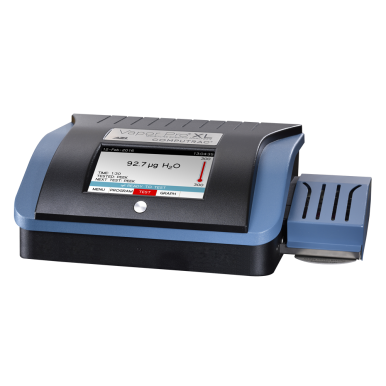
The AMETEK Brookfield Computrac Vapor Pro XL is designed to measure water released from a heated sample.
The material is placed within a crimp-top vial and heated under controlled conditions. Dry air or nitrogen carries the evolved vapour to a relative humidity sensor, allowing the analyser to determine water content rather than relying on the overall mass lost from the sample.
This moisture-specific principle is relevant where other volatile constituents could affect a loss-on-drying result. It also provides a reagent-free route for suitable applications that would otherwise use Karl Fischer titration, subject to appropriate method development and correlation.
The Vapor Pro XL supports programmable test conditions and retained results, helping laboratory and production teams apply an established method consistently.
The analyser does not determine the correct moisture limit for a Stratasys material, nor does a passing result alone guarantee the quality of a printed component. Its role is to provide the measured water result required by the wider material-control procedure.
A documented RAF and Stratasys application
Able’s published Mission Critical Moisture Control application describes how Stratasys had standardised on the Computrac Vapor Pro XL as its recommended moisture-specific analyser for filament quality control.
When supplying an FDM printing system to the RAF, Stratasys advised the RAF of the instrument. The RAF subsequently identified its availability through Able and procured the analyser. Able then worked with the RAF to develop test parameters for the application of ULTEM™ high-performance polymer.
The published account also records a target below 0.04%, or 400 ppm, within the material-control context described. That value should not be treated as a universal limit for every Stratasys filament or FDM application. The applicable requirement must be confirmed for the particular material and controlled process.
The significance of the application is not the threshold alone. It demonstrates the difference between assuming that material has been dried and using a defined measurement method to verify its condition before use.
Application support and measurement traceability
Establishing reliable Stratasys filament moisture testing requires more than instrument selection.
Method development may require evaluation of sample handling, test temperature, endpoint criteria, expected moisture level and correlation with an existing reference method. The procedure must then be applied consistently and supported by appropriate calibration, verification and operator training.
Able Instruments is AMETEK Brookfield’s Exclusive UK and Ireland Partner and European Service Centre for the Computrac range. Able provides application consultation, method-development assistance, training, traceable calibration, maintenance and repair support.
It is also useful to distinguish between two forms of traceability:
- Measurement traceability: The calibration and verification of the instrument and its measurement performance
- Process traceability: The connection between the result, material, method, operator, acceptance limit and production decision
Both may be important, but one does not automatically provide the other.
Does every Stratasys filament have the same moisture limit?
No. Moisture limits and drying requirements may vary by material, printing process and application. The relevant Stratasys material guidance or approved internal procedure should be used rather than applying one threshold across every filament.
The 400 ppm figure in Able’s published RAF application relates to the specific material-control context documented there and should not automatically be applied to other materials.
Can a filament dryer confirm that material is ready to print?
A dryer can confirm that its conditioning programme has run, but it does not normally measure the water remaining within the filament.
A separate moisture test is required where the material condition itself must be verified and documented.
Why can total mass loss differ from water content in some polymers?
Loss-on-drying measures the total mass released during heating. Where a material releases substances other than water, the result may include those additional volatiles.
Moisture-specific analysis measures evolved water, helping distinguish water content from other sources of sample mass loss. The suitability of either method depends on the material and required procedure.
When should a moisture-specific method be correlated with Karl Fischer?
Correlation should be considered where Karl Fischer is the approved reference method and a moisture-specific analyser is being introduced for routine testing.
The required validation or correlation should be defined before changing an approved quality-control procedure. A correlated alternative does not make Karl Fischer unsuitable or unnecessary in every application.
What this means for engineers
A controlled drying process remains important, but it should not be mistaken for a measured moisture result.
Where Stratasys material condition must be verified:
- Define the material-specific moisture requirement
- Establish a controlled and repeatable test method
- Measure the material after conditioning
- Retain the result against the relevant material or batch
- Define what happens when the result falls outside the acceptance limit
- Maintain the analyser through appropriate calibration and service
The Vapor Pro XL provides the measurement mechanism. The traceability and reliability of the result come from combining that measurement with a suitable method, documented material limits and a controlled quality procedure.
Next steps
Understanding how moisture verification fits within Stratasys material-control procedures is central to producing documented and supportable results before printing.
If you are reviewing how filament condition is verified following drying or storage, it is worth assessing whether the current procedure measures the remaining water content and records that result against the relevant material or batch.
Explore the range: Moisture in Solids Analysers
Email: [email protected]
Telephone: 01189 311 188

Share this with
X Facebook LinkedIn Email