When does fixed ATEX clamp-on flow measurement make sense?
Announcements | Thursday, 18th June Share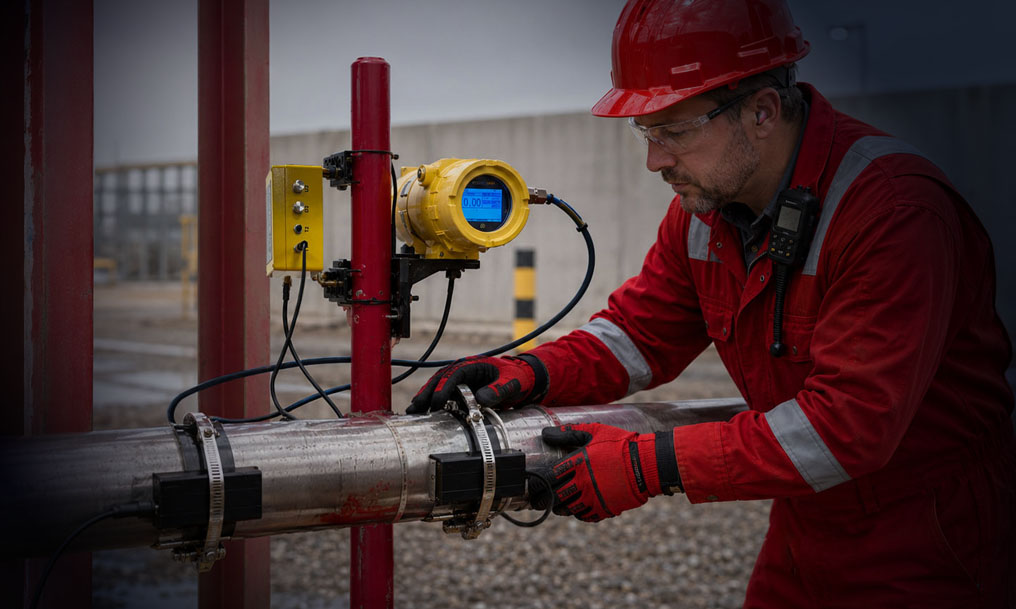
In many hazardous area liquid applications, selecting a fixed flow measurement approach depends not only on the meter technology, but on how the measurement point can be installed into existing pipework.
Liquid flow measurement in Zone 1 or Zone 2 hazardous areas can involve more than choosing an instrument with the correct certification. Engineers may also need to consider pipework access, process interruption, installation method, cable routing, output requirements and the practical implications of adding a measurement point to an existing line.
In some applications, an inline flow meter is the right engineering choice. In others, the mechanical work required to cut into pipework, introduce flanged connections or modify an existing line may add unnecessary complexity.
For suitable liquid duties, fixed ATEX clamp-on flow measurement provides a different route. By measuring from outside the pipe, it can help reduce process intrusion and avoid cutting into pipework, provided the pipe, fluid and installation conditions support ultrasonic measurement.
When does fixed ATEX clamp-on flow measurement make sense?
Fixed ATEX clamp-on flow measurement makes sense when a hazardous area liquid line needs a longer-term installed measurement point, cutting into pipework is undesirable, and the pipe, fluid and installation conditions are suitable for ultrasonic measurement, with application review confirming the non-invasive route is appropriate.
In practice, this most commonly applies where:
- A fixed flow measurement point is required in a Zone 1 or Zone 2 hazardous area
- Engineers want to avoid cutting into existing pipework where suitable
- The liquid and pipework can support reliable ultrasonic signal transmission
- The application requires plant outputs, documentation and long-term measurement rather than a temporary flow check
Application challenges in hazardous area flow measurement
Hazardous area flow measurement often sits at the point where process measurement, mechanical installation and site procedures overlap. Even where the measurement objective is clear, the route to installation may need careful consideration.
Typical factors include:
- Hazardous area classification and certification requirements
- Pipe material, pipe size, wall thickness and pipe condition
- Liquid type, process temperature and flow profile
- Available straight pipe run and transducer mounting position
- Required outputs and communication requirements for plant monitoring or site systems
- Site access, installation procedures and documentation requirements
Where an intrusive installation is justified, an inline meter may remain the correct option. However, where the application supports non-invasive measurement, a fixed clamp-on approach can help engineers establish a longer-term installed measurement point without adding wetted meter components or new process connections.
Common specification pitfalls
Specifying by hazardous area approval alone
ATEX suitability is essential in a classified area, but it does not confirm whether the measurement principle is right for the process. Pipework, liquid condition and installation geometry still need to be reviewed.
Assuming all liquids suit transit-time ultrasonic measurement
Transit-time ultrasonic measurement relies on reliable signal transmission through the pipe and liquid. Significant gas bubbles, solids, slurry, aeration or unsuitable pipe conditions may affect suitability and require closer review.
Using a temporary flow check to define a longer-term measurement requirement
Portable measurement can be useful for investigation or verification, but a fixed hazardous area system may need additional consideration around outputs, mounting, documentation and long-term integration.
Over-specifying before reviewing the duty
Some applications genuinely require a high-specification inline flow technology. Others may be better served by a practical fixed clamp-on approach, provided the measurement requirement and installation conditions support it.
What makes clamp-on ultrasonic measurement relevant?
Clamp-on ultrasonic flow measurement uses externally mounted transducers to send ultrasonic signals through the pipe wall and liquid. In transit-time measurement, the system compares the time taken for ultrasonic signals to travel with and against the direction of flow. The difference between those signal times is used to calculate flow velocity.
Because the sensors are mounted outside the pipe, the instrument does not need to contact the process fluid. This can be useful where pipework modification, process compatibility or installation access are important considerations.
For hazardous area use, the full system arrangement matters as well as the measurement principle. Engineers need to consider the certified equipment arrangement, installation method, cable routing, outputs, configuration approach and supporting documentation.
The practical question is not simply whether clamp-on ultrasonic measurement can measure liquid flow. The question is whether the full installation is suitable for the specific hazardous area application.
Where the Micronics UX5000 fits
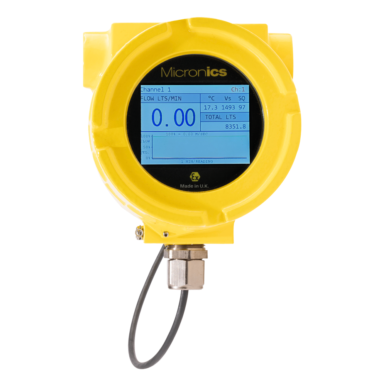
The Micronics UX5000 is a fixed ATEX ultrasonic clamp-on flow meter for suitable Zone 1 and Zone 2 liquid flow applications. It is designed for longer-term non-invasive measurement where the pipework, liquid and installation conditions support transit-time ultrasonic measurement.
The UX5000 is particularly relevant where engineers need a fixed hazardous area measurement point but want to avoid cutting into pipework where the application allows. It may be considered for hazardous area process lines, chemical and petrochemical sites, utilities and industrial water applications, subject to application review.
It should not be treated as a one-size-fits-all answer. Where the liquid contains significant gas bubbles, solids, slurry or heavy aeration, or where pipe conditions are unsuitable, another flow measurement technology may be more appropriate.
Within Able’s wider flow measurement portfolio, the UX5000 provides a practical fixed ATEX clamp-on option where non-invasive installation, hazardous area suitability and application-led support are all important.
What information should engineers review first?
Before specifying fixed ATEX clamp-on flow measurement, it is useful to gather enough application information to confirm whether the approach is suitable.
At minimum, engineers should normally review:
- Pipe size, pipe material and wall thickness
- Liquid type, flow range and process temperature
- Hazardous area classification
- Available straight pipe run
- Required outputs and communication requirements
- Sensor access, mounting position and cable routing
- The reason measurement is required, such as monitoring, verification, troubleshooting or project integration
This early review helps determine whether fixed clamp-on ultrasonic measurement is suitable, whether further technical assessment is needed, or whether another flow technology should be considered.
Engineering support
Specification of fixed ATEX clamp-on flow measurement requires consideration of both the measurement duty and the installation environment. Able Instruments supports this through:
- Review of pipework, liquid conditions and hazardous area classification
- Guidance on whether clamp-on ultrasonic measurement is suitable
- Advice on alternative flow measurement technologies where required
- Support with documentation, configuration and project requirements
For wider guidance on ATEX flow meters for hazardous area applications, Able can advise on the most suitable approach based on the process conditions, measurement objective and installation constraints.
Able is also Micronics’ Exclusive Representative for Sales and Service in the UK and Ireland for the UX5000. Further information on Micronics ultrasonic flow meters is available through Able’s Micronics brand page.
Frequently asked questions (FAQs)
Is fixed ATEX clamp-on flow measurement suitable for every hazardous area liquid application?
No. Fixed ATEX clamp-on flow measurement is suitable only where the pipework, liquid and installation conditions support the measurement principle. Transit-time ultrasonic measurement generally requires reliable ultrasonic signal transmission through the pipe and liquid, so applications with significant gas bubbles, solids, slurry, aeration or unsuitable pipe conditions may need closer review or an alternative technology.
What information is needed before specifying a fixed ATEX clamp-on system?
Engineers should normally provide pipe size, pipe material, wall thickness, liquid type, flow range, process temperature, hazardous area classification, available straight pipe run, required outputs and installation constraints. The measurement objective should also be clear, because ongoing monitoring, process verification and project integration may each place different demands on the specification.
Is clamp-on ultrasonic measurement always better than an inline flow meter?
No. Clamp-on ultrasonic measurement can be a practical option where non-invasive installation is beneficial and the application conditions are suitable. However, some duties may be better served by Coriolis, differential pressure, electromagnetic, thermal or another flow measurement technology.
What this means for engineers
Fixed ATEX clamp-on flow measurement is best treated as an application-specific option rather than a default replacement for every intrusive flow meter installation.
Fixed ATEX clamp-on flow measurement should normally be considered where the installation method is a major part of the specification decision, not simply where a hazardous area flow meter is required.
It can be a strong fit where a hazardous area liquid line requires longer-term measurement, where cutting into pipework is undesirable, and where the pipe and liquid conditions are suitable for ultrasonic measurement.
The correct decision depends on application review. In some cases, the UX5000 may provide a practical, non-invasive route to fixed hazardous area flow measurement. In others, a different flow technology may be the better engineering choice.
This is typically where early application review helps prevent the measurement route being chosen before the duty is fully understood.
If you are assessing fixed ATEX clamp-on flow measurement for a hazardous area liquid application, it may be useful to review the pipework, liquid conditions, installation constraints and measurement objective before selecting a system.
Explore the UX5000: Micronics UX5000 ATEX Zone 1 ultrasonic clamp-on flow meter
Email: [email protected]
Telephone: 01189 311 188

Share this with
X Facebook LinkedIn Email