Temperature and Process Controllers
Panel-Mount Temperature and Process Control
Able Instruments supply temperature and process controllers that compare a measured temperature or analogue process input with a setpoint and operate configured outputs to regulate connected equipment. This category brings together Dwyer panel-mounted controllers in 1/16, 1/8 and 1/4 DIN formats.
Selection depends on panel size, input type, control-output arrangement, PID functions, alarms, programming, communications and power supply. Some Dwyer families provide two control outputs from one universal measurement input. This should not be interpreted as two independent process inputs.
Quick Select by Requirement
Why Choose a Temperature or Process Controller?
A temperature controller receives a signal from a supported temperature sensor, compares the measured value with its setpoint and adjusts the selected control output. A process controller follows the same principle using a supported analogue signal representing another process variable.
Universal-input controllers can support either type of duty when correctly configured. The selected input, scaling, output hardware and connected control equipment must all suit the application.
When Temperature and Process Controllers Are a Strong Fit
These panel-mounted controllers suit OEM machinery, ovens, environmental chambers, packaging equipment and industrial process systems where one measured variable must be regulated locally. Depending on the selected family and configuration, the controller can provide PID control, alarms, programmable operation and integration with a wider control or monitoring system.
Key Considerations Before Specifying
Start with the physical installation and measurement input, then define the control and integration requirements.
- Panel size and cut-out: Confirm the required 1/16, 1/8 or 1/4 DIN format, available panel space and installation depth.
- Input and scaling: Identify the temperature sensor or analogue process signal and confirm its supported range and scaling requirements.
- Control-output arrangement: Define the required relay, voltage-pulse, current or voltage interfaces and how each output will be used.
- Control function: Confirm whether the application requires on/off, PID, manual or heating and cooling control, subject to the selected family.
- Alarms and programming: Establish the required alarm behaviour and whether ramp/soak or other programmed setpoint operation is needed.
- Communications and power: Check RS-485 or Modbus requirements, controller supply and compatibility with the wider system.
Dwyer Controller Family Selection
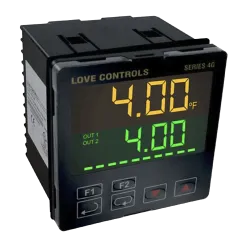
The Dwyer Series 16G/8G/4G provides a related controller platform across 1/16, 1/8 and 1/4 DIN panel sizes. It uses one universal measurement input with two primary control outputs and standard RS-485 communications.
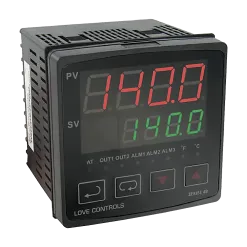
The Dwyer Series 4B provides a dedicated 1/4 DIN route with universal input, configurable outputs, PID functions and programmable ramp/soak operation.
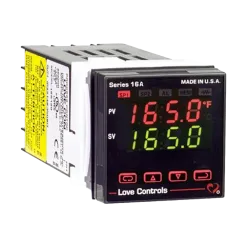
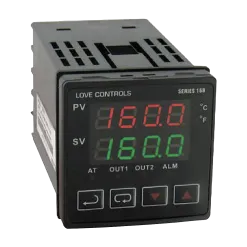
For compact 1/16 DIN installations, the Dwyer Series 16A combines universal-input and self-tuning PID capability, with outputs, alarm provision and communications determined by the selected 16A2 or 16A3 configuration. The Dwyer Series 16B uses one universal measurement input with two control outputs, a dedicated alarm relay and standard RS-485.
Able Instruments are an official UK channel partner for DwyerOmega. Able can help define the panel format, input, output arrangement, controller functions and communications required before quotation.
Temperature and Process Controller Support
Able Instruments can help match the controller family and configuration to the measured variable, control objective and wider system requirements.
- Application qualification: Clarifying the measured variable, control objective, operating sequence and replacement context.
- Family selection: Guidance comparing DIN size, input capability, output arrangement and controller functions.
- Configuration compatibility: Support checking outputs, alarms, ramp/soak functions, communications, power supply and selected options.
- Integration and documentation: Help confirming panel installation, wiring interfaces, communications and the information needed for specification.
Temperature and Process Controllers: Frequently Asked Questions
What is the difference between a temperature controller and a process controller?
A temperature controller is configured for a supported temperature sensor such as a thermocouple or RTD. A process controller is configured for a supported analogue signal representing another process variable. Universal-input controllers may support either duty, but the input type and scaling must be selected for the application.
What do 1/16 DIN, 1/8 DIN and 1/4 DIN mean?
These DIN designations describe standardised front-panel formats and associated panel cut-outs. A 1/16 DIN controller has a smaller front face than a 1/8 or 1/4 DIN controller. Confirm the exact cut-out, installation depth and panel space for the selected family.
How do I choose between the Dwyer controller families?
Begin with the required DIN size and input, then compare the output arrangement, control functions, alarms, programming, communications and power supply. Series 16G/8G/4G provides the broadest panel-size choice, Series 4B is the dedicated 1/4 DIN ramp/soak route, and Series 16A and 16B provide different compact 1/16 DIN configurations.
What does dual-loop or dual-output mean on these controllers?
It does not mean two independent measurement inputs in this category. On Series 16G/8G/4G and Series 16B, one universal measurement input is paired with two control outputs. These outputs can support arrangements such as heating and cooling, subject to the selected output hardware and configuration.
Can these controllers accept both temperature sensors and analogue process signals?
The universal-input families can be configured for supported thermocouples, RTDs or DC current and voltage signals. The exact input types, ranges and any required auxiliary hardware vary by family and configuration. Each Phase 1 family uses one measurement input.
+ Learn More