Magnetic and Electromagnetic Flow Meters
Electromagnetic Flow Measurement for Conductive Liquids
Magnetic flow meters, also called electromagnetic flow meters or magmeters, measure the volumetric flow of electrically conductive liquids. They apply Faraday’s law of electromagnetic induction and, in conventional designs, have no moving measuring element in the flow stream.
Able’s magnetic-flow range is led by McCrometer and supports selection for water, wastewater and compatible process-liquid duties. Start by confirming liquid conductivity, pipe size, flow range, installation route, process conditions, wetted materials and the required outputs.
Why Choose a Magnetic Flow Meter?
Electromagnetic measurement provides an unobstructed route for conductive-liquid flow measurement without a mechanical measuring element in the bore. This can reduce wear and pressure-loss concerns associated with some mechanical technologies, but performance and suitability still depend on the selected meter and installation.
When Electromagnetic Flow Measurement Is a Strong Fit
Magnetic flow meters are well suited to many water and wastewater applications and can also serve compatible conductive process liquids. They are not suitable for liquids that do not meet the selected meter’s conductivity requirement. Pipe condition, whether the pipe remains full, installation geometry and material compatibility must also be checked for the chosen design.
Full-Bore or Insertion Measurement?
A full-bore or in-line meter forms a complete metering section within the pipeline. It may be preferred where a defined meter bore, liner and electrode arrangement is required, subject to the available pipework, process interruption and installation conditions.
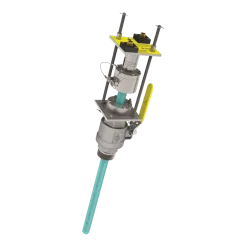
An insertion meter introduces a sensor through the pipe wall and can provide a practical route for large pipes, retrofit projects or sites where replacing a full pipe section would be difficult. The McCrometer FPI Mag uses a full-profile, multi-electrode insertion design. For full-bore requirements, Able can assess the wider McCrometer range against the pipework, duty and integration needs.
Key Considerations Before Specifying
Confirm the process and installation conditions before choosing a magnetic flow-meter type.
- Liquid conductivity: Verify that the medium meets the selected meter’s conductivity requirement rather than applying one universal threshold.
- Meter and installation type: Compare full-bore and insertion routes against access, retrofit constraints, process interruption and the required measurement performance.
- Pipe and flow conditions: Confirm pipe size, expected minimum and maximum flow, whether the pipe remains full and the available upstream and downstream installation conditions.
- Materials and medium: Check liner, electrode, sensor, seal and other wetted materials against the liquid and any solids or chemical constituents.
- Pressure and temperature: Verify the process limits for the selected sensor, meter body, liner, connections and transmitter arrangement.
- Power and integration: Define the required power, display, analogue or pulse outputs, communications, totalisation and system-integration needs.
McCrometer Magnetic Flow Expertise
Able Instruments are McCrometer’s exclusive representative for sales and service in the UK and Ireland. McCrometer is Able’s preferred magnetic and electromagnetic flow-meter range, spanning full-bore and insertion designs for different pipework and installation requirements.
Able can help qualify the application, compare the installation approaches and select an appropriate McCrometer route. Detailed accuracy, straight-run, grounding, materials, pressure, temperature, power and output requirements must be confirmed for the chosen product and configuration.
Where the liquid is not sufficiently conductive, or a non-invasive external installation is preferred, consider whether an ultrasonic clamp-on flow meter is suitable for the application.
Magnetic Flow Meter Selection Support
Able Instruments can help match a magnetic or electromagnetic flow meter to the liquid, pipework, operating conditions and measurement objective.
- Application qualification: Clarifying the liquid, conductivity, pipe size, flow range and required measurement performance.
- Meter type selection: Comparing full-bore and insertion routes against access, retrofit constraints and process interruption.
- Materials and limits: Support checking wetted materials, pressure, temperature and installation requirements.
- Outputs and integration: Help defining power, display, outputs, communications, totalisation and connection to the wider system.
Magnetic and Electromagnetic Flow Meters: Frequently Asked Questions
Are magnetic and electromagnetic flow meters the same technology?
Yes. Magnetic flow meter, electromagnetic flow meter, mag meter and magmeter are commonly used names for instruments that apply electromagnetic induction to measure the velocity of an electrically conductive liquid.
What liquids can an electromagnetic flow meter measure?
Electromagnetic flow meters require an electrically conductive liquid. Water and wastewater are common applications, while other process liquids may be suitable when their conductivity, the selected wetted materials and the operating conditions are compatible with the meter.
Why does liquid conductivity matter?
The measuring principle depends on a conductive liquid moving through a magnetic field and generating an electrical signal. If conductivity is too low for the selected meter, a reliable measurement cannot be made. The required minimum is model specific.
What is the difference between a full-bore and an insertion magnetic flow meter?
A full-bore meter is installed as a complete metering section in the pipeline. An insertion meter places a sensor through the pipe wall and can be advantageous for large pipes or retrofit projects. Accuracy, installation, straight-run and process requirements remain product specific.
Can a magnetic flow meter measure oil or another non-conductive liquid?
Not if the liquid is insufficiently conductive for the selected instrument. Confirm the medium and conductivity before specification. Where electromagnetic measurement is unsuitable, Able can help assess another flow-measurement technology.
+ Learn More