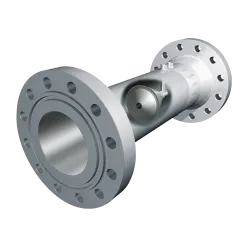
Differential Pressure Flow Meters
Differential Pressure (DP) flow meters are a time-proven technology for measuring fluid flow in industrial applications. They operate on Bernoulli’s principle, where an obstruction in the pipe creates a pressure drop that is proportional to the square of the flow velocity. By measuring the pressure difference across this constriction (using a DP transmitter), the flow rate of liquids, gases, or steam can be determined. DP flow meters have been used for over a century due to their reliability and versatility, finding applications across oil & gas, water treatment, chemical processing, power generation, and many other industries that require accurate and robust flow measurement.
How DP Flow Measurement Works
When fluid passes through a restriction (the primary element of a DP meter), its velocity increases and pressure decreases at the constriction. Upstream of the restriction the pressure is higher, and downstream it is lower; this pressure differential is measured by a secondary element (DP transmitter). According to Bernoulli’s equation, the flow rate is proportional to the square root of the pressure drop, assuming constant fluid density. In practice, each DP flow meter primary (orifice, Venturi, etc.) has a calibrated discharge coefficient to relate DP to flow. The DP transmitter outputs a signal that is processed to yield flow rate. This simple principle, combined with modern transmitters, yields robust flow measurements that are critical for process control, custody transfer, and safety monitoring.
Types of Differential Pressure Flow Meters
Several types of primary elements create the differential pressure in DP flow meters. Here we introduce five major types: Orifice Plate, Venturi Tube, Flow Nozzle, Pitot Tube, and V-Cone. Each uses a different geometry to constrict flow, with its own advantages and limitations.
Orifice Plate Flow Meters:
The orifice plate is the simplest and most common DP flow meter. It’s a thin metal plate with a sharp-edged hole, mounted between flanges in the pipe. As fluid flows through the orifice, it experiences a sudden constriction, causing a drop in pressure which is measured via taps on either side of the plate.
Merits: Orifice plates are inexpensive and easy to install (they simply bolt between flanges). They have no moving parts and are standardized by international norms (e.g. ISO 5167), so their flow calculations are well-understood. They can be used in a wide range of services (liquids, gases, steam) and sizes, and maintenance is straightforward – plates can be replaced if damaged or to change the measurement range.
Limitations: Orifice meters incur a relatively high permanent pressure loss (energy loss) because the sudden contraction and expansion dissipates energy. The sharp edge can wear down or accumulate debris, which degrades accuracy over time. They also require long straight pipe runs upstream (and some downstream) to ensure a fully developed flow profile; otherwise measurement uncertainty increases. Additionally, the flow range (turndown) is limited (typically about 3:1) because at low flows the DP signal becomes very small.
Typical Applications: Orifice plates are widely used in general-purpose flow measurements where cost and simplicity are important. They appear in industries from oil/gas (measuring fuel gas, refinery flows) to water/wastewater and HVAC. Orifice meters are often chosen for standard installations where moderate accuracy (within ~1% of reading) is acceptable and pressure loss is not a critical concern.
Venturi Tube Flow Meters:
A Venturi meter uses a gradually converging section, a narrow throat, and a diverging section to measure flow. The fluid smoothly accelerates into the throat, then decelerates in the diffuser, allowing much of the pressure drop to be recovered. The Venturi design was introduced in the late 19th century and remains a popular DP meter for larger flows.
Merits: Venturi tubes cause low permanent pressure loss – the smooth expansion in the diffuser enables recovery of typically 80–90% of the pressure drop. This makes them energy-efficient for flow measurement. They also provide higher accuracy (uncertainty roughly 0.7–1.5% of reading depending on design), often around ±0.5% in well-calibrated applications. Venturis can handle wet or dirty fluids better than orifices, because their gradual shape is less prone to catching debris. They are used for liquids, gases, or even steam, and have been trusted for critical measurements (e.g. custody transfer of fluids) where minimising pressure drop is crucial.
Limitations: Venturi meters are bulkier and more expensive than orifice plates. The meter itself has a long body (especially the diffuser section), and they typically require very long upstream straight pipe runs (and sometimes flow straightening vanes) to achieve their accuracy specs. Installation can be complex due to the meter’s size and the need for flange connections or welding into the pipe. While the pressure recovery is high, a small pressure loss still occurs (especially if a shortened diffuser is used). Like all DP devices, Venturis have a limited turndown (~3:1) for a single DP transmitter range. Lastly, their higher cost and installation requirements mean Venturis are usually justified in applications that demand their unique strengths (accuracy with low pressure loss).
Typical Applications: Venturi flow meters are often found in high-flow pipelines where pressure drop must be minimised – for example, water transmission lines, municipal water treatment, and large oil/gas pipelines. They are also used for flow measurement in steam plants and industrial gas lines for billing or process control. Their reliability and accuracy make them suitable for custody transfer (e.g. natural gas metering) and other critical services, provided sufficient installation space is available.
Flow Nozzle Flow Meters:
A flow nozzle is essentially a hybrid of an orifice and a venturi. It has a smooth converging inlet to a narrow throat, but unlike a Venturi, it has no long diffuser section. The flow nozzle produces a DP by accelerating the fluid through a nozzle-shaped restriction. This design is more streamlined than an orifice, but shorter than a Venturi.
Merits: Flow nozzles have a higher flow capacity and can handle higher velocities than orifice plates without suffering damage. The smooth contoured inlet results in a high discharge coefficient and less sensitivity to wear (no sharp edge). They are relatively compact in length compared to Venturi tubes and typically cheaper than a full Venturi meter. Installation is often via flange or weld between pipe sections, similar to an orifice plate assembly. Nozzles are well-suited for high-temperature, high-pressure flows (such as steam) where an orifice might erode; in fact, they are widely used for steam flow measurement in power plants. Maintenance intervals can be long since the rigid design withstands harsh conditions.
Limitations: A flow nozzle recovers less pressure than a Venturi tube – its permanent pressure loss is higher (though still a bit lower than a sharp orifice). This means some energy is lost in the flow nozzle measurement. Installation, while easier than a Venturi, is more involved than an orifice plate (which just slips in between flanges). Often, custom fittings or welding is needed for nozzles, and they are not adjustable once installed. They also require straight piping runs for accurate measurement (though generally a bit less than an orifice). Turndown ratio is in the same ballpark (~3:1) as other DP devices. If not properly engineered, flow nozzles can be more difficult to inspect or replace than orifice plates, leading to higher maintenance effort in some cases.
Typical Applications: Flow nozzles are used in high-velocity and high-energy flows. Common examples are superheated steam lines, feedwater, and other high-pressure fluids in power generation and petrochemical plants. They are also applied where solids are entrained in the fluid or the fluid is erosive, since the rounded nozzle edge is more robust than an orifice plate’s sharp edge. In summary, the flow nozzle is a good choice when you need a durable DP meter for extreme conditions but want less pressure loss than an orifice and can’t accommodate a full Venturi tube.
Pitot Tube Flow Meters:
A Pitot tube is a simple device that measures fluid velocity at a point by capturing the stagnation pressure. The classic Pitot tube (invented by Henri Pitot in the 1700s) consists of a small tube inserted into the flow, with an opening facing upstream to measure total pressure and a side opening to measure static pressure. The difference between these pressures gives the dynamic pressure, which correlates to flow velocity. In flow applications, often an averaging Pitot tube (also called an Annubar) is used, which has multiple sensing ports across the pipe diameter to measure the average flow velocity profile.
Merits: Pitot tubes are prized for their simplicity and very low pressure loss. Because they only insert a small tube into the flow, they cause essentially no permanent pressure drop in the system – a major advantage when pressure loss must be avoided. They are also cheap and easy to install; a single penetration in the pipe (via a tap or flange) is used to mount the probe. Many pitot probes can even be hot-tapped (inserted without shutting down flow) and removed for inspection while the process is running. With an averaging Pitot design, they can achieve reasonable accuracy (often about ±1% of reading for liquids) over a cross-section. Pitot meters are commonly used for large ducts or stack gas flows where installing a full-bore flow meter would be impractical or too costly. They are lightweight and a good fit for retrofit situations in large existing pipes.
Limitations: A single-point Pitot gives only a local velocity; if the flow profile is not uniform, this can lead to error. The averaging Pitot tube addresses this by sampling multiple points, but it still assumes a fully developed flow profile. Therefore, some upstream straight run is needed (though requirements can be shorter, e.g. some designs can be installed ~2 diameters downstream of an elbow). Pitot tubes produce a relatively small differential pressure, especially at low flow velocities, which can limit their measurement resolution and turndown. Typically, the flow range might be 3:1 to 5:1 for a given DP transmitter, similar to orifice-based systems. They also cannot handle fluids with heavy particulate or fouling – the small sensing holes can clog if the fluid carries dirt or condensate. Proper alignment with the flow is critical; misalignment can introduce significant error. In summary, while very useful for certain applications, Pitot tubes trade off some accuracy and range for extremely low intrusion and cost.
Typical Applications: Pitot and averaging pitot tubes are commonly used for air and gas flow measurements, such as HVAC ducts, ventilation systems, and flue gas monitoring, where pressure loss must be minimized. They are also used in large diameter water mains or intakes where installing a full pipe meter would be expensive. Because of their low cost, Pitot probes serve in many monitoring applications (e.g. checking flow in an existing system). In general, they are chosen for large or retrofit installations and situations where moderate accuracy is acceptable in exchange for simplicity and negligible pressure drop.
V-Cone Flow Meters:
The V-Cone® flow meter is a modern DP meter that introduces a cone-shaped element into the center of the pipe, facing upstream. Developed by McCrometer in the 1980s, it features a conical obstruction that forces flow to pass around it, creating a differential pressure between the upstream side of the cone and the downstream side (which has an annular opening). The V-Cone is essentially an advancement of DP technology, combining benefits of other meters while mitigating some drawbacks.
Merits: The V-Cone’s most notable advantage is its built-in flow conditioning design. The cone shapes the velocity profile and induces controlled turbulence, meaning the meter requires minimal straight pipe lengths for accurate measurement – as little as 0–5 diameters upstream and only 0–3 diameters downstream in many cases. This is far less than orifice or Venturi meters need, allowing installation in tight spaces and retrofit applications where straight-run piping is limited. Despite the short upstream requirement, it achieves high accuracy, typically ±0.5% of rate (when calibrated) over a broad flow range. In fact, each V-Cone can be individually flow-calibrated (determining its K-factor), yielding excellent repeatability and reliability. The meter also offers a wide turndown ratio of 10:1 (or even more in some cases), significantly better than the ~3:1 of standard DP meters. This means it can measure a much broader span of flow rates with one instrument. Additionally, the V-Cone incurs a low permanent pressure loss – comparable to a Venturi – because the gradual constriction around the cone and expansion downstream minimize energy dissipation. The design creates a lower amplitude, higher frequency pressure signal which tends to be very stable, reducing noise on the DP reading. The V-Cone has no moving parts and a robust construction (various stainless steels and alloys are available), resulting in low maintenance requirements even in abrasive or harsh fluid conditions. Some designs/configurations can even measure bi-directional flow, as the cone geometry is symmetric front-to-back (though typically this might require special calibration or dual transmitters).
Limitations: As a more complex, engineered device, the V-Cone comes at a higher initial cost than simple devices like an orifice plate. It is installed as a spool piece (a section of pipe with the cone element inside), which means cutting the pipe and adding flanges similar to installing a Venturi tube. Thus, while it saves space in terms of straight run, it still requires a section to be fitted in the line. In very large pipe sizes, the cone element and spool weight can be substantial. Being a proprietary/advanced design (McCrometer invented it and held patents), historically there have been limited suppliers for cone meters, though the technology is now more widely available. However, given the long lifespan, energy savings from reduced pressure loss, and better performance, the lifecycle costs are often justified. Overall, the downsides are minor compared to its benefits, especially for challenging applications.
Typical Applications: The V-Cone is often the meter of choice for demanding applications where other DP meters falter. It is used in oil and gas production (including offshore platforms) for its compactness and ability to handle dirty or wet gas flows. In chemical and petrochemical plants it measures fluids that may be corrosive or inhomogeneous, thanks to its robust build and flow conditioning. It’s popular in refineries and power plants for steam and fuel measurements where space is tight and accuracy is paramount. The V-Cone also sees use in water and wastewater systems, mining (slurries), and any scenario where installation constraints (limited straight run or tight footprint) exist alongside a need for high accuracy. Essentially, when you need a high-performance DP meter with minimal piping hassle, the V-Cone is an ideal solution.
Comparison Table
| Meter Type | Accuracy | Pressure Loss | Installation Complexity | Space Requirements | Turndown Ratio | Ideal Use Cases |
|---|---|---|---|---|---|---|
| Orifice Plate | Moderate (±1%) | High | Low | High (long straight runs) | Low (~3:1) | General industry, cost-sensitive applications |
| Venturi Tube | High (±0.7% to ±1.5%) | Low | High | High | Low (~3:1) | Water, oil/gas pipelines, custody transfer |
| Flow Nozzle | Medium (±1%) | Medium-High | Medium | Moderate | Low (~3:1) | Steam, high-pressure gas, erosive fluids |
| Pitot Tube | Low/Medium (±1-2%) | Minimal | Low | Low | Low (~3:1 to 5:1) | HVAC, large ducts, stack monitoring |
| V-Cone | High (±0.5%) | Low | Medium | Low (compact) | High (10:1+) | Retrofits, compact installs, harsh flows |
Note: All the above DP meters require knowledge of fluid density (or use pressure-temperature compensation for gases) to compute mass or volumetric flow. In terms of maintenance, none have moving parts, but orifices and pitot tubes may need more frequent inspection/cleaning, whereas Venturi, nozzle, and V-Cone tend to have longer maintenance cycles.
The McCrometer V-Cone® Advantage
McCrometer’s V-Cone flow meter is positioned as a premium choice among differential pressure flow technologies, combining the strengths of traditional devices with modern innovation. Below are key reasons why the V-Cone stands out:
- Superior Accuracy & Reliability: Thanks to its unique design, the V-Cone delivers ±0.5% accuracy of actual flow rate (with proper calibration) and excellent repeatability. It consistently maintains accuracy even in distorted or swirling flow conditions that would upset other meters. When accuracy and repeatability are critical, the V-Cone’s performance brings superior value over orifice plates or Pitot tubes.
- Wide Turndown Range: The V-Cone offers a typical 10:1 turndown ratio (or greater), allowing one meter to cover a wide span of flow rates. This flexibility means it can handle variable process conditions without sacrificing accuracy at low flows – a significant advantage over Venturis and orifices which are usually limited to about 3:1 without multiple transmitters.
- Built-In Flow Conditioning: The conical element acts as its own flow straightener, conditioning the flow by smoothing out disturbances. As a result, the V-Cone can be installed with minimal straight-pipe upstream or downstream. For customers, this reduces the footprint and installation cost since long settling lengths or additional flow conditioners aren’t needed. It’s especially beneficial in tight-fit installations where long straight runs are impractical or unavailable – for example, on offshore platforms, skid-mounted equipment, or retrofitting an existing plant line.
- Low Pressure Loss: In many applications, saving energy is as important as measurement. The V-Cone’s efficient recovery of pressure means very low permanent pressure loss, comparable to a Venturi tube. This low headloss design can translate to lower pumping costs over time and makes the V-Cone suitable for measuring compressible flows (gas/steam) where pressure drop must be minimised.
- Bi-Directional Capability: Unlike some DP elements that only measure flow in one direction, the V-Cone can be configured to measure flow in either direction (with appropriate transmitter setups). This is useful in applications like pipeline networks or injection/withdrawal systems where flow may reverse. The symmetric cone design enables measuring reverse flow with maintained accuracy, adding versatility.
- Robust, Low-Maintenance Design: The V-Cone has no moving parts and is built from durable materials (stainless steels, high-grade alloys). It handles harsh environments and abrasive or dirty fluids with ease. The cone element tends to direct debris away, and there’s no sharp edge to erode as in an orifice plate. This yields long-term stability and minimal maintenance – a big plus for remote or hard-to-access installations. Users report that the V-Cone often outlasts other flow technologies in challenging service and maintains calibration longer, resulting in lower lifecycle costs.
- Compact & Retrofit-Friendly: Because it replaces long straight runs and separate flow conditioners, the V-Cone often simplifies piping layouts. It can fit into constrained spaces (even vertical pipes or near elbows) that would defeat other meters. For retrofit projects, the V-Cone can be manufactured as a spool piece that drops into the existing line with flanged or welded connections, avoiding major re-piping. This installation flexibility means it can be placed virtually anywhere in the system – a significant cost saving when modifying existing facilities.
- Trusted Solution: First introduced in 1985, the McCrometer V-Cone has a long track record with over 75,000 installations worldwide. It’s a well-proven technology, backed by McCrometer’s extensive expertise in flow metering. McCrometer, as a leading flow meter manufacturer, ensures each V-Cone is carefully calibrated and tested. Moreover, McCrometer’s global support network provides assistance from selection to commissioning. In the UK, Able Instruments is the official sales and service partner for McCrometer V-Cone meters, reflecting the confidence in this product. Users get the peace of mind of both a trusted manufacturer and a local partner for support. In short, the V-Cone represents state-of-the-art DP flow measurement, and its adoption across industries speaks to its performance and quality.
Conclusion
Differential pressure flow meters continue to be a cornerstone of industrial flow measurement, each type offering a balance of pros and cons. For businesses and engineers, understanding these differences is key to selecting the right solution. If minimising energy loss and maximising accuracy in a tight footprint is the priority, McCrometer’s V-Cone Flow Meter emerges as the premium choice among DP meters. It delivers accurate, repeatable flow data with minimal installation hassle, backed by decades of proven performance. McCrometer is a trusted name in flow technology, and with Able Instruments as the official UK partner, customers have local expertise and support in deploying V-Cone meters for their critical applications. In the end, the optimal flow meter is one that best fits the application’s needs – and the V-Cone is designed to meet the toughest requirements with confidence.
+ Learn More