Able’s clamp-on systems have no moving parts and offer the advantage of minimal installation requirements in terms of cost, time and hardware. In addition, Able systems are completely non-invasive ensuring there are no potential fugitive emission points and there is no pressure drop as a result of installation, providing real long-term benefits to users. In particular the non-invasive design provides continuous savings by lowering the costs associated with running pumps, a cost that is often underestimated when considering the effects of flow meter installation. Also, no by-pass lines or isolation valves are required for maintenance and consequently there is no need for process shutdown during commissioning or routine maintenance.
Most importantly the patented signal processing techniques employed within Able systems allow them to provide accurate flow and media information in the face of difficult conditions and applications such as aeration, particulate, low flows and small pipes. The ability to read under adverse conditions is significant for what may be considered relatively straightforward installations, as it is rare that an application remains stable, and most are usually subject to some kind of process cycling.
The “re-locatable” nature of these devices, along with their wide applicability, means that they can be used on temporary installations during process set-up and to check existing flowmeter installations as well as providing significant benefits in “permanent” applications.
Having successfully solved some of industries toughest applications, Able are recognised experts in both contact and non-contact ultrasonic flow measurement alike. Our expertise and reputation are in many respects unparalleled in the field of ultrasonic flow measurement, which is borne out by the numerous requests we receive to provide papers for international organisations and seminars.
Able’s unique RigilokTM transducer positioning system
Considerable experience in the offshore sector has led Able to develop the world’s first positive transducer location and fixing technique. RigilokTM is a stainless steel framework that is either welded or clamped to the pipe and secures the transducers into their desired position. Whilst all systems that are supplied into hostile environments are complete with stainless steel corrosion resistant high precision transducers, Able can also offer the additional protection of full 316 stainless steel shrouding. Able’s patented shroud design has been used on numerous applications worldwide and is available in specialised materials upon request. Whilst RigilokTM and shrouding are generally supplied for dedicated units, some installations such as fire pump lines utilise a portable meter to survey a number of fixed points where protected transducers are sited. Shrouding can also be supplied with portable systems and allows portable systems to be left in exposed areas.
Cargo Transfer Meter (CTM) – Offload Metering System
In the mid 1990’s Able turned its attention to addressing one of the most challenging flow applications, high accuracy offload metering, with the development of a specialised system named the Cargo Transfer Meter (CTM).
CTM is a high performance flowmeter for allocation duties in pipes from 2 to 48”. Typical applications include measuring oil movements between production units, monitoring separator flows and being employed as the metering station at jetty offtake and loading points for tankers.
These systems combine extraordinary bi-directional flow range, reliability, and wide applicability of Able’s nonintrusive Clamp-On Transit-Time ultrasonic technology, with the simple installation and accuracy of a factory calibrated spool section. All CTM Systems include intrinsic sonic density detection for mass flow measurement. CTM delivers fully optimised “out of the box” accuracy by combining factory controlled pipe dimensions, precision transducer installation, plus optional factory flow calibration and flow profile conditioning.
Notable for its low weight and small footprint, unrestricted flow throughput and negligible maintenance requirement, the system is ideally suited to the Floating Production, Storage and Offload (FPSO) unit, as well as the FSU, Semi-Sub or Fixed production platform.
Taking Ultrasonic Metering to New Heights – Continuous Technological Innovation – the Able SlugMaster
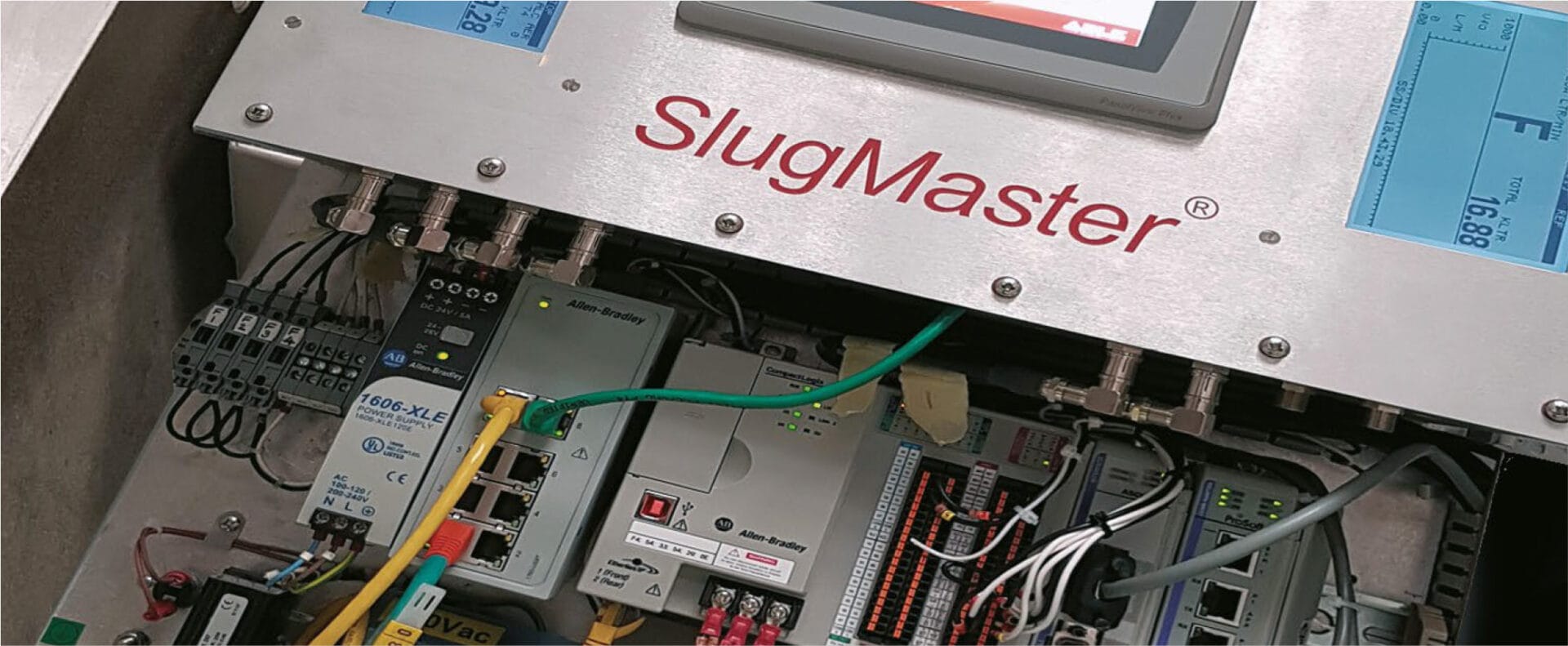
Able’s next innovation in the field of clamp-on ultrasonics was the SlugMaster, an intelligent, dual technology flow meter specifically developed to consistently measure liquid flow without interruptions caused by changing process parameters.
When oil is pumped over a considerable distance, usually between the wellhead and installation, often large pockets of gas or congealed oil will build up at elevated points in the pipeline. As the velocity in the pipeline increases, the gas pockets and congealed oil is dislodged and flows towards
the platform or processing unit. At this point, a slug catcher is typically employed to vent off the gas and remove the congealed oil for processing. Accurate flow measurement of the oil from the outlet
of the slug catcher is vital for allocation and billing purposes. The difficult process conditions of slugging due to heavy fluctuating aeration, and slurry or solid particle entrainment are not ideal for most flow meters. Furthermore, the inherent coating in this process rules out any insertion type flow meters for this application.
Able’s time of flight ultrasonic flow meters have exceptional measurement accuracy, even with small levels of aeration. In the Able SlugMaster® system, this accuracy is used to calibrate a tandem Reflexor meter during the window when both meters are able to operate due to low aeration in the fluid. By calibrating the Reflexor to the time of flight at the point where time of flight is just failing to measure, the Reflexor becomes vastly more accurate than a standard Reflexor out of the box. Ordinarily, the changeover point between these two technologies would be difficult to achieve, yet with the Able SlugMaster®, an accurate and seamless changeover between the two metering technologies is achieved with unique mathematical software that enables accuracies that exceed the raw changeover of both meters.
The SlugMaster has proved to be a great success across a number of high-profile assets in the North Sea and was the foundation stone for the Able “Master” Series of process control instrumentation, the ethos and purpose of which is sustainability of measurement during process upsets which would defeat conventional meters.
Around 2014, Able embarked upon their greatest metering related challenge to date, the design and build of the World’s 1st Multiphase Non-Contact Wet Gas Meter.
PhaseMaster is a multi-phase variant of SlugMaster, incorporating radiometric densitometer technology. The First Clamp-On Multi-phase Meter delivers individual phase component measurements in an oil/water/gas stream. It was subsequently trialled successfully by Total on Dunbar Platform where it facilitated discrete oil and gas measurement from test separator in a mixed medium – the most challenging multiphase demanding in the oil and gas industry. During a subsequent TUV NEL sponsored Joint Industry Project (JIP), the PhaseMaster demonstrated better than 1% uncertainty for liquid and 5% for gas.
Patented Gas Volume Fraction (GVF) Flow Correction Algorithm
The two-phase version of the multiphase flow meter uses a vertical cross pipe density chord measurement to measure the gas volume fraction. For the purpose of GVF description, the gas density is considered to be virtually zero in comparison to the liquid component. The GVF is considered to be of a value of 0.00 (0.0%) when the pipe is full of just liquid product, and effectively 1.00 (100%) when the pipe is completely empty of liquid product. In the program we process the liquid fraction which is the reverse, and after adjustment for the pipe wall, the calibration is set to measure 1.00 when the pipe is full of liquid, and 0.00 when the pipe is empty of liquid. This can be predetermined by maths calculations. In a control application the liquid and gas densities are set in the configuration program. When the program is running, the transition from 0.00 to 1.00 is not linear, and is a product of a maths sine function to conform to the shape of the pipe. The result is proportional to the liquid fraction in the pipe. The result is the same for gas entrained liquid as it is for stratified gas on liquid layers since the resultant cross pipe liquid fraction measurement is the same.
The liquid flow rate from the raw flow computer measurement is then multiplied by a liquid fraction formula measurement which is processed from a 4-20mA input from the densitometer. As a result, the Multiphase SlugMaster derives a liquid only flow measurement. By applying additional gas slip algorithms, the gas flow may also be derived from the same formula. In the real-life application, the density of the crude and the gas will vary. Yet the magnitude of the difference between the gas and the liquid densities will remain largely the same, and temperature correction is sufficient to adjust for changes in the product. This will ensure a good liquid flow uncertainty for control applications even with varying liquid densities. Typically, we would expect better than ±5%. If higher accuracy (< ±2%) is required there is an enhanced variant available which requires an additional densitometer.
Multi-Phase allows for a more efficient operation of the separation units, which can be set up more accurately. The clear benefit is the higher quality and quantity of the oil output. An additional benefit is that an improved separation process reduces wasteful gas flaring.
Multiphase Patent Awarded
As testimony to our innovation in the field of clamp-on ultrasonics, In 2017 Able Instruments & Controls Ltd were awarded a patent for their latest invention entitled “Providing measurements relating to different phase components of a flowing fluid”.
This latest advancement is a product of Able’s innovative Research & Development Division, specialists in ultrasonic metering techniques, and is designed to address difficult process parameters across varying media. The patent covers the core technology at the heart of Able’s current and projected MasterTM Series of instrumentation, which uses a dual measurement intelligent algorithm to resolve demanding application challenges and consistently deliver accurate flow measurements during process upsets and fluctuations in composition.
Summary
Able’s pedigree in clamp-on ultrasonic flow measurement is unquestionable. From pioneering the first North Sea installations to developing a patented, intelligent meter which uses voting algorithms to determine what technology is suitable for the process condition. Able will continue to lead the way in advancing the measurement so that accurate, repeatable and sustainable performance is possible across the industries that need it.
Have a particular application / project in mind? We’d welcome a call on +44 (0)118 9311 188 or alternatively, email us now at info@ableinstruments.com
This category is overseen by our industrial process expert,
Dave Quelch.