
How should temperature control and limiting be specified for hazardous area trace heating?
Announcements | Friday, 14th August Share
Hazardous area trace-heating systems can require temperature control, temperature limiting or both functions together.
Electric trace heating is used across industrial applications where equipment needs to remain within a required temperature range. Typical duties include freeze protection, process temperature control, over-temperature control and viscosity control.
In hazardous areas, selecting the temperature-control equipment involves more than matching a temperature range. The required control function, hazardous area classification, electrical load, installation arrangement and method of configuration all need to be considered as part of the complete trace-heating system.
A key distinction is whether the application requires temperature control, temperature limiting or both. These functions perform different roles and should not be treated as interchangeable.
How should temperature control and limiting be specified for hazardous area trace heating?
Temperature control and limiting should be specified by first establishing whether the trace-heating application requires a controller, a limiter or both functions together. The selected equipment should then be matched to the hazardous area classification, electrical and thermal requirements, installation arrangement and required method of configuration or monitoring.
Where an Ex component is used, its certification applies to the component itself. It must still be incorporated into suitable equipment or an enclosure in accordance with the applicable certification and the requirements of the final installation.
If these requirements are not matched, the selected device may not provide the required function or certified scope for the intended installation.
Why controller and limiter functions are different
A temperature controller manages heater operation according to the measured temperature, configured setpoint and hysteresis. In a two-point control arrangement, the heating circuit is energised or de-energised according to these parameters.
A temperature limiter performs a different function. When its defined limiting temperature is reached, the heating circuit is de-energised and heating is not restored until the limiter has been manually reset.
Where both functions are required, a combined controller and limiter can provide temperature control and temperature limiting within the same configuration.
The starting point for specification is therefore the required function of the trace-heating system. Communication options, interface features and other configuration choices should follow that decision rather than determine it.
Specification points that can be overlooked
Several factors need to be considered together when selecting temperature-control equipment for hazardous area trace heating.
Controller, limiter or combined functionality
The required duty should be established before the individual product configuration is selected. A controller and limiter perform different functions, while a combined configuration provides both.
Hazardous area certification scope
Configurations within the same product family do not necessarily have identical hazardous area certification. The certified scope of the selected configuration therefore needs to match the requirements of the final application.
Component certification versus finished equipment
An Ex component is not the same as finished Ex equipment. The conditions attached to its component certification still need to be addressed when it is incorporated into the final enclosure or equipment.
Electrical and thermal limits
A headline switching-current value should not be considered in isolation. Supply voltage, load current, ambient and service temperature, permitted surface temperature and the certified operating limits may all affect selection.
Configuration and monitoring
Local adjustment, indication and remote communications may be available in different combinations. The required interface should reflect how the installed system will actually be commissioned, configured and monitored.
Hazardous area classification and Ex component certification
Hazardous area suitability needs to be assessed at configuration level rather than assuming that every version of a controller family carries the same certified scope.
The Barksdale Kelvin range illustrates this distinction. BHTC controller and BHTL limiter configurations are ATEX/IECEx Ex components with an EPL Gb/Db certified scope, while the combined BHTLC controller and limiter has an EPL Gc/Dc scope.
Kelvin is supplied as an Ex component rather than a finished stand-alone enclosure. Its certification requires incorporation into suitable equipment or an enclosure, including enclosure protection of at least IP65 and installation that prevents the component from being susceptible to UV light.
These requirements demonstrate why the component certificate should form part of the wider installation assessment rather than being treated as a stand-alone approval for the completed equipment.
How IEC/IEEE 60079-30-1 relates to temperature control and limiting
IEC/IEEE 60079-30-1 forms part of the technical framework for electrical resistance trace-heating systems in explosive atmospheres.
Within the current Kelvin certification, the BHTC controller, BHTL limiter and BHTLC combined controller and limiter meet the applicable IEC/IEEE 60079-30-1 requirements within their respective certified scopes.
Where the limiter function is used, Kelvin’s certification also requires the user to demonstrate the ability to predict the offset (ΔToffset) between the trace-heating sheath temperature and the temperature-control device setpoint in accordance with the applicable IEC/IEEE 60079-30-1 requirement.
This is an important part of limiter specification because the selected setpoint cannot be considered independently of the relationship between the measured control temperature and the trace-heating sheath temperature.
The standard reference should therefore be considered alongside the required control or limiting function and the conditions of the complete trace-heating installation.
It should not be interpreted as meaning that selection of a compliant component alone defines the suitability of the finished system. The hazardous area classification, electrical duty, installation conditions and certification requirements of the final equipment still need to be considered.
Electrical, thermal and interface considerations
Once the required control and limiting functions have been established, the electrical and thermal conditions of the application need to be matched to the selected equipment.
For example, different Kelvin configurations have different switching limits. BHTC and BHTL configurations can switch loads up to 30 A within the applicable certified limits, while BHTLC is limited to a maximum of 22 A. Allowable load also depends on factors including operating temperature and permitted surface temperature.
Supply-voltage requirements and protective-device selection likewise need to be checked against the applicable configuration and certification conditions.
The required method of configuration and monitoring is another consideration. Depending on the Kelvin configuration, options include dial-based setpoint adjustment, LED indication, Modbus RTU and Bluetooth.
Modbus configurations support remote parameter setting and monitoring of operating and device-status information. Bluetooth-equipped configurations support local programming and monitoring through the Bluetooth app.
The appropriate interface therefore depends on how the final installation is intended to be commissioned, accessed and monitored.
Where the Barksdale Kelvin fits
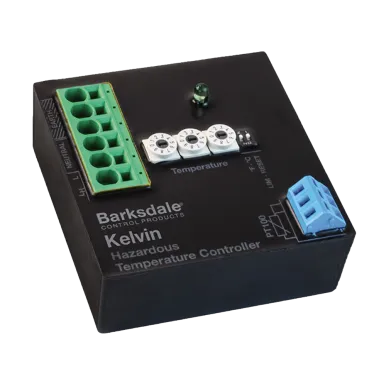
The Barksdale Kelvin ATEX/IECEx Temperature Controller and Limiter is designed for electronic temperature measurement, monitoring, control and limiting in electric trace-heating and industrial process applications.
Three principal configurations separate the required functions:
- BHTC: Temperature controller
- BHTL: Temperature limiter
- BHTLC: Combined temperature controller and limiter
This allows the control function to be selected first, before considering the associated hazardous area scope, electrical duty and interface configuration.
Kelvin uses a Pt100 RTD input, while interface options vary by configuration and can include dial adjustment, LED indication, Modbus and Bluetooth.
The detailed electrical ratings and certification markings should be checked for the selected configuration and final application rather than assumed to apply uniformly across the complete range.
Application and configuration support
Able Instruments is Barksdale’s Master Distributor in the UK and Ireland, providing application guidance, configuration support and technical assistance for Barksdale instrumentation.
For Kelvin applications, this can include reviewing whether controller, limiter or combined functionality is required, considering the relevant hazardous area classification, checking electrical-load and enclosure requirements, and identifying suitable interface options before the final configuration is selected.
This is particularly relevant where the temperature-control component forms part of a wider heat-trace assembly, OEM system or integrated control solution, because product selection needs to reflect the requirements of the complete installation.
What is the difference between a temperature controller and a temperature limiter?
A temperature controller manages heater operation according to the measured temperature, setpoint and hysteresis. A temperature limiter provides a separate limiting function, de-energising the heating circuit when its defined limiting temperature is reached and requiring manual reset before heating is restored.
The required function should therefore be established from the trace-heating application rather than assuming that a controller and limiter perform the same duty.
When might temperature control and limiting both be required?
Where the application or system design requires both normal temperature control and a separate temperature-limiting function, a combined controller and limiter configuration can provide both functions.
The requirement for both functions should be determined from the application, system design and applicable technical requirements rather than assumed solely from the hazardous area classification.
What does Ex component certification mean for the final installation?
An Ex component is not certified as complete finished equipment in its own right. It must be incorporated into suitable equipment or an enclosure in accordance with the applicable component certificate and installation conditions.
For the Barksdale Kelvin, the current certification includes requirements for an enclosure providing at least IP65 protection and for installation that prevents the component from being susceptible to UV light.
Do all Barksdale Kelvin configurations have the same hazardous area scope?
No. BHTC controller and BHTL limiter configurations have an EPL Gb/Db certified scope, while the combined BHTLC controller and limiter has an EPL Gc/Dc scope.
The required hazardous area classification therefore needs to form part of configuration selection.
What this means for engineers
Correct specification of hazardous area trace-heating temperature control starts with defining the function required by the application.
A structured selection process should consider:
- Whether temperature control, limiting or both functions are required
- The hazardous area classification and certified scope of the selected configuration
- Whether the device is finished equipment or an Ex component requiring integration
- The electrical load and applicable thermal operating limits
- The requirements of the final enclosure or equipment
- The appropriate local or remote configuration and monitoring interface
The individual product specification is only one part of that process. Correct selection depends on matching the controller or limiter to the requirements of the complete trace-heating installation.
Next steps
Where hazardous area trace-heating control is being specified, the required function and certified scope form the basis for later electrical, enclosure and interface decisions.
If you are reviewing a new or existing trace-heating application, it is worth confirming that the selected configuration matches both the required temperature-control function and the conditions of the final installation.
Explore the range: Temperature Switches
Email: [email protected]
Telephone: 01189 311 188

Share this with
X Facebook LinkedIn Email